Foam jacking, also called polyurethane foam injection or poly jacking, is a concrete lifting method that uses two-part polyurethane foam to fill voids under settled concrete slabs and raise them back to their original position. It’s lighter, faster, more permanent, and more precise than traditional mudjacking, which uses a heavy slurry of mud and cement.
We’ve lifted everything from small concrete steps to barn floors using this foam, and the principle is always the same. The two-part polyurethane starts as a liquid, we inject it through small holes drilled in the concrete, and as the two parts mix, they create a chemical reaction that produces foam. That foam expands to fill every void and crack under your slab, and as it expands, it lifts the concrete. The expansion is powerful but controlled, which is why we can lift your driveway an inch and a half without cracking it.
Kansas City Needs Foam Jacking
Kansas City sits on what’s called expansive clay soil, and if you’ve lived here for more than a year, you already know what that means. When we get heavy rain, that clay absorbs water and swells up. When we go through a dry spell, it contracts and shrinks. That constant expansion and contraction creates voids under your concrete, and eventually, the slab settles into those voids. Drive down any residential street in Parkville, Smithville, Olathe, Independence, Kearney, or Liberty, and you’ll see driveways that have settled near the garage, sidewalks that have sunk, creating trip hazards, or patio slabs that now slope toward the house instead of away from it. That’s not because the concrete is bad. It’s because the soil underneath is moving.
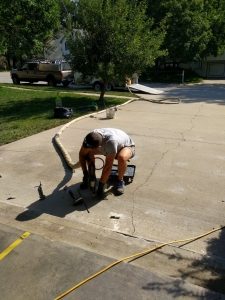
When we show up to do a foam jacking job, the first thing we do is figure out exactly where the voids are under your concrete and how much lift you need. We’re not guessing. We’re using levels and measuring the actual amount of settlement. Then we mark where we need to drill. For a typical driveway that’s sunk near the garage, we might drill six to ten holes, each one about five-eighths of an inch in diameter. Those holes are small enough that once we patch them, you’ll barely notice they were ever there.
The actual injection process is where it gets interesting. We’ve got two components in our truck, and they mix together right at the injection point. When they combine, you get this expanding foam that’s finding every void under your slab. You can actually watch your concrete lift in real time. We’re talking about lifting several thousand pounds of concrete with foam that weighs maybe 2 pounds per cubic foot when it’s fully expanded. Compare that to mudjacking material which weighs somewhere around a hundred and twenty pounds per cubic foot, and you start to understand why the foam doesn’t create additional load on the soil underneath.
The whole process for a standard residential driveway takes maybe 2-3 hours. Thirty minutes after we’re done, you can park your car on it. Try getting that kind of turnaround time with any other concrete repair method.
Foam Jacking vs Mudjacking
Let’s talk about foam jacking versus mudjacking because people ask us about this constantly. Traditional mudjacking pumps a slurry of water, soil, sand, and cement under your concrete through much larger holes, usually about 2″ in diameter. That material is heavy; it can wash out over time if water gets underneath your slab, and it takes longer to cure. The holes are bigger and more noticeable even after you patch them. But here’s the real difference. That mudjacking slurry adds weight to whatever’s underneath your concrete. If your soil couldn’t support the weight of your concrete slab to begin with, adding more heavy material under it isn’t solving the actual problem. It’s just temporarily filling the void with something that might itself settle over time.
The foam we use doesn’t have any of those issues. It’s waterproof, so it won’t erode or wash out. It’s incredibly light, so it’s not adding load to your soil. And it expands to fill every crack and crevice, creating a more complete support system under your slab. Once that foam cures, it’s done. It’s not going to break down, compress, or deteriorate. We’ve been doing this since 2012, and we’ve never had a foam jacking job fail due to the foam itself. The only time we’ve had to come back and do additional work is when someone had multiple voids and we addressed one of them but not all of them, or when the soil around the area we lifted continues to settle and creates new problems.
If the height difference between concrete slabs is ¼” or more, it’s time to get a quote. Addressing these issues is crucial. Over time, gaps in concrete slabs can get bigger, and so does the damage and erosion. For driveways by a garage, it’s even more important to prevent costly foundation problems. Thirty percent (30%) of our foam jacking jobs involve re-lifting concrete that has previously undergone unsuccessful traditional mud jacking.
Small Jobs? No Problem! We Handle Them All!
At Concrete Raising Systems, we complete projects of all sizes. We understand that even minor concrete issues can be major problems, and we’re here to help.
How much does it cost to lift concrete with foam?
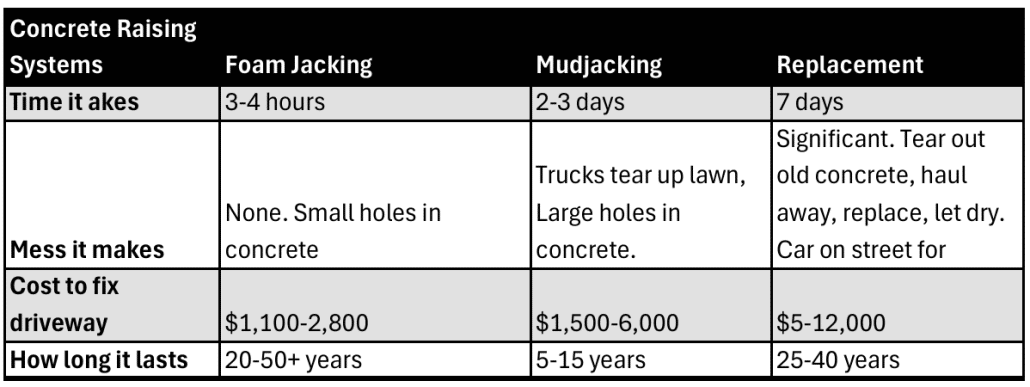
The question we get most often after explaining the process is what does foam jacking actually cost. For a residential driveway in Kansas City, you’re typically looking at somewhere between $1,100 and $2,800. That’s a pretty wide range, so lets break down what affects the price. The size of the area matters obviously. Lifting a small sidewalk section that’s maybe four feet by four feet is going to cost less than lifting your entire driveway. The amount of void underneath matters too. If your concrete has only settled an inch, we need less foam than if it’s dropped four inches. And finally, how many separate sections need lifting affects the total. If your driveway has three different areas that have settled, that’s more drilling, more injection points, and more foam than if it’s one continuous settled section.
Here’s how that compares to your other options. Replacing that same driveway would run you anywhere from $5,000 to $12,000, depending on the size and current market rates for concrete. You’d have to demolish the old concrete, haul it away, prepare the base, form up the new pour, wait for good weather, pour the concrete, wait for it to cure, and then you still couldn’t drive on it for at least a week. During all of that, your cars are parked on the street and you’re walking through construction dust every time you go in or out of your house. Or you could have us lift it in three hours for a fraction of that cost and drive on it the same day.
Foam Jacking vs Traditional Mudjacking. A Clear Winner.
Thirty percent of the concrete repair jobs we do are to lift a concrete driveway or sidewalk back into place again after traditional mud jacking has failed.
The Power of Expanding Foam in Concrete Leveling
Our two-part polyurethane foam expands upon injection, like shaving cream, reaching every void and ensuring complete support for your concrete. This expanding foam can flow up to 7 feet under a concrete slab, providing comprehensive and long-lasting results.
Stories like this happen a lot
Last month, we did a job in Kansas City where the homeowner’s driveway had settled about three inches near the garage. He’d been putting it off because he thought he was going to have to replace the whole driveway, and he’d gotten a quote for fourteen thousand dollars. When we showed up and explained foam jacking, he was skeptical. I get it. It sounds too good to be true. But we drilled our holes, started injecting, and within about five minutes, he was watching his driveway rise back up. His exact words were, ‘Why doesn’t everyone know about this?’ And honestly, that’s a great question. More people should know about foam jacking, and we’re working on it.
We work with:
homeowners
real estate agents
building owners
property managers
home builders
homeowners associations
Local Kansas City Expertise
We are a locally owned and operated business serving the Kansas City area. Call us at (816) 419-8306 for a competitive bid on Foam Jacking using state-of-the-art polyurethane foam. Choose Concrete Raising Systems for a long-lasting, reliable solution to your concrete problems. Lift it with us, and you lift it once!