
The Ground Is Disappearing Under Your Concrete: What KC Homeowners Need to Know
Right now, beneath your driveway, sidewalk, or garage slab, there is a good chance an empty air pocket is spreading. Most homeowners won’t notice until a heavy car tire rolls over a slab and makes it bounce, or until a sidewalk edge snaps off clean along the grass line.
In the trade, we call these hollow spots voids. They happen naturally across the Kansas City metro because our thick clay soil swells up tight during soggy springs and shrinks drastically during summer heat waves. Whenever roof runoff or gutter downspouts pour water along the borders of your flatwork, loose subsoil washes away with it. That leaves your driveway or front walk hovering in midair.
When a Concrete Slab Turns into an Accidental Bridge
Concrete is engineered to push heavy weight straight down onto dense, compacted earth. The moment the dirt washes out, that slab turns into an accidental bridge. Nobody engineered your front porch or your two-car garage to act like a bridge, and sooner or later, a standard slab carrying heavy vehicle traffic without a solid base will buckle under the strain.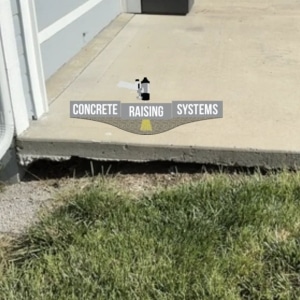
Warning Signs Under Garages, Driveways, and Patios
Garage floors tend to be the sneakiest. Because the concrete is inside and shielded from rain, surface washouts do not show up around the perimeter. Instead, you hear it. You pull your truck in after work and notice a strange, booming hollow echo underneath the front tires. You might even feel a brief shudder through the floorboard. Those tiny hairline cracks running down the middle of the bay usually mean you need garage floor concrete leveling before the slab sags further into the empty pocket below.
Out on the driveway, the symptoms are easier to spot. You will see slabs tipping away from each other, long jagged cracks running toward the street apron, or a visible gap opening up right along the garage door threshold. If you walk along the outer lawn edge of the flatwork, you can often shine a flashlight straight back underneath. Those dark gaps quickly become prime nesting dens for yellow jackets, mice, burrowing groundhogs, and wolf spiders. When the drop becomes noticeable, professional driveway concrete lifting restores an even, supported surface.
Patios and walkways show the damage just as clearly. A quick way to test a patio is to measure the step coming out of the back door. Standard residential code sets stair risers at about seven and three-quarters inches. If your patio step has crept up past eight or nine inches, your patio is sinking down into an expanding void. Over along the walkway, unlevel slabs create instant trip hazards that can easily send a guest or neighbor straight to the emergency room with a fractured wrist. Addressing these gaps early with sidewalk repair and leveling prevents serious liability risks.
If you are currently house hunting in Johnson, Jackson, or Clay County, take a minute during your walk-through to kick away the fresh mulch banked up against the front walk and patio steps. Sellers and flippers frequently dump a fresh layer of wood chips over sunken concrete to hide major soil washouts from home inspectors.
Why Traditional Mudjacking Fails Over Time
Fixing an unsupported slab used to mean traditional mudjacking. Contractors would drill heavy two-inch holes across your flatwork and pump in hundreds of pounds of wet dirt, water, and cement. That old slurry is notoriously heavy, which only adds stress to weak subsoil, and it easily washes right back out during the next wet spring. In fact, about forty percent of the repair calls we handle across Kansas City are redos on old mudjacking jobs that washed out after three or four seasons. You can read more about why this happens in our guide on polyurethane foam versus mudjacking.
Permanent Void Filling with High-Density Polyurethane
Our crew uses closed-cell structural polyurethane foam instead. We drill tiny five-eighths-inch injection ports, about the size of a dime, right through the affected slab. We inject expanding liquid polyurethane directly into the hollow spaces underneath. As it expands, it forces out trapped water, fills every crevice, locks the loose dirt together, and gently levers the concrete back up to a flat grade.
Once the slab is level, we patch the tiny holes to match the rest of your concrete. If any foam is exposed along an open dirt edge, simply backfilling a little topsoil or fresh mulch over it protects the material from sunlight and keeps it rock-solid for decades.
Polyurethane cures completely within fifteen minutes. You do not have to park on the street for two days waiting for heavy mud slurry or brand-new concrete to set up. More importantly, lifting an existing slab before it shatters into pieces saves thousands of dollars over the mess of jackhammering, hauling, and repouring.
Schedule a Free Inspection Across the Kansas City Metro
Concrete Raising Systems works on driveways, garage slabs, pool surrounds, and walkways across the entire Kansas City area, including Overland Park, Olathe, Lee’s Summit, and North Kansas City. We provide free on-site inspections, walk you through exactly what is happening under your slabs, and never ask for a deposit before the repair is finished. Contact our team today or call (816) 419-8306 to get that hollow ground stabilized before your slab gives out.
Frequently Asked Questions About Concrete Void Filling
What causes voids under concrete slabs in the Kansas City metro?
Kansas City sits on expansive clay soil that shifts dramatically through changing seasons. During hot, dry summer stretches, the clay shrinks and pulls away from the concrete. Heavy spring downpours and freeze-thaw cycles in winter then wash out loose subsoil, especially around downspouts, poorly compacted backfill, and driveway borders. Over time, these combined forces leave large empty pockets of air beneath driveways, sidewalks, and garage slabs.
How does polyurethane foam fix hollow spaces under concrete?
Technicians drill small 5/8-inch holes (about the size of a dime) into the concrete directly over the void. A two-part closed-cell polyurethane foam is injected into the space as a liquid. Within seconds, it expands into an ultra-dense, structural foam that completely fills the void, stabilizes the weak subsoil, and lifts settled slabs back up to their proper grade. Once cured, the drill holes are patched with a cementitious compound to match the surrounding surface.
How long does polyurethane void filling last compared to traditional mudjacking?
Polyurethane foam provides a permanent repair. Traditional mudjacking pumps a heavy mixture of water, soil, and Portland cement, which adds substantial weight onto already unstable soil and is vulnerable to washing out again over time. Polyurethane foam is hydrophobic (impervious to water), will not erode or degrade in damp soil, and adds almost no excess weight to the subbase.
How quickly can I park on my driveway or garage floor after injection?
Polyurethane foam expands and cures within 15 to 30 minutes. Unlike mudjacking or freshly poured replacement concrete—which often requires 24 to 72 hours of curing—polyurethane repairs can handle full passenger vehicle traffic and foot traffic almost immediately after the crew finishes patching the drill holes.
Can filling a void save concrete from needing full replacement?
Yes, as long as the concrete slab is structurally intact and hasn’t fragmented into dozens of small, pulverized pieces. Filling subgrade voids restores direct load support to the concrete before heavy vehicular or foot traffic snaps the slab. Catching and filling a void early typically costs a fraction of the price of tearing out and repouring new concrete.
Does polyurethane foam attract insects, rodents, or other pests?
No. Closed-cell geotechnical polyurethane foam offers no nutritional value or nesting incentive to insects or burrowing animals. In fact, filling concrete voids eliminates the sheltered cavities beneath driveways and sidewalks that pests like skunks, groundhogs, yellow jackets, snakes, and spiders frequently use as dens.